 how-to
Mobile Locksmith Service Area Limits: What You Need to Know
Last Updated: October 23, 2026
Quick Summary
A mobile locksmith service area is the geographic region a locksmith covers when responding to calls, affecting response time, travel charges, and whether they can help at all. Service area limits exist because locksmiths can't maintain same-day emergency response across a 45-minute radius.
- Most locksmiths define territory by drive time rather than distance to account for traffic variations.
- Commercial coverage often extends farther than residential because scheduled jobs have higher value and can absorb travel costs.
- Response time promises and technician availability are the primary factors determining how large a service area a locksmith can cover.
- Always confirm your address falls within the service area and ask about travel fees before booking.
- Commercial work like master key systems and multi-unit rekeys justifies wider travel radius than single residential lockouts.
Table of Contents
- What Mobile Locksmith Service Area Limits Actually Mean
- How Service-Area Boundaries Are Determined
- Understanding Your Locksmith Service Area Coverage
- Emergency Locksmith Response Time and Service Limits
- What to Ask a Locksmith Before Booking Service
- Travel Fees and Out-of-Area Service Charges
- Residential, Commercial, and Automotive Coverage Differences
- Conclusion
- Frequently Asked Questions
What Mobile Locksmith Service Area Limits Actually Mean
At Locksmith Of Gilbert, we serve the eastern valley of the greater Phoenix area, spanning neighborhoods and nearby communities where we can guarantee prompt arrival and reliable service.
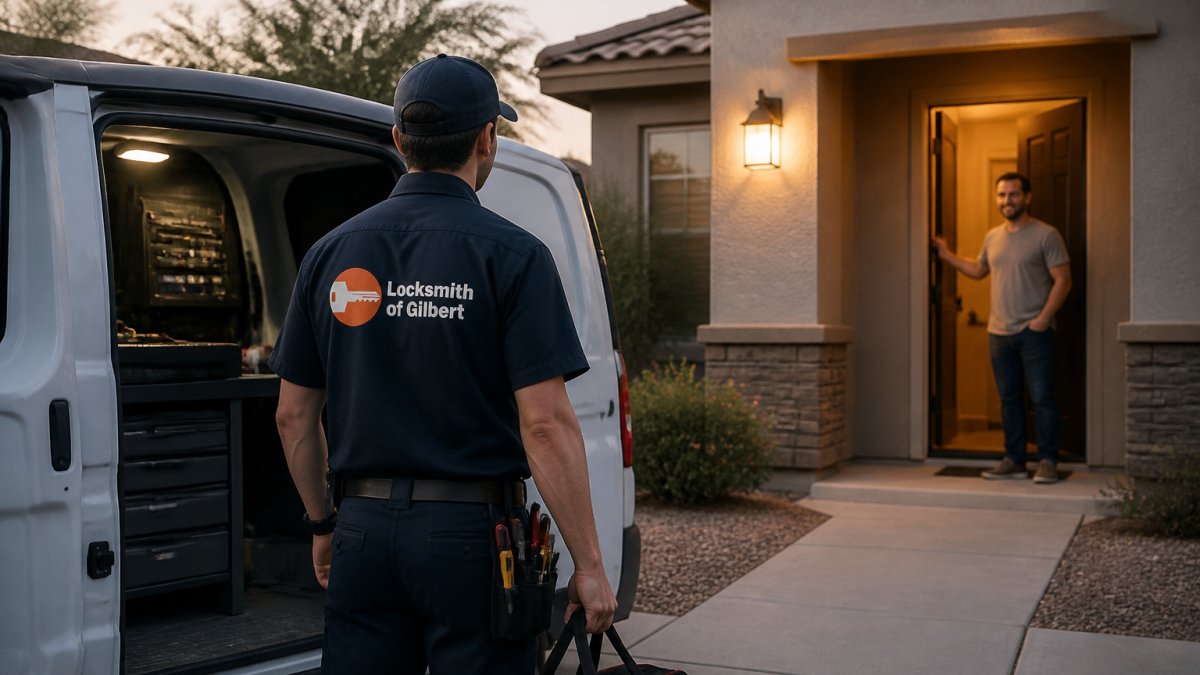
Service area limits exist for practical reasons: a locksmith can't serve customers 45 minutes away and still maintain same-day emergency response.
Most mobile locksmiths define territory by drive time, not distance, 15 minutes in city traffic differs vastly from 15 minutes on open highway.
How Service-Area Boundaries Are Determined
Locksmith service areas are set by response-time commitments and operational capacity. A business promising 30-minute emergency response can't cover a 60-minute radius.
Several factors shape where a locksmith draws the line:
- Response time promises. If you guarantee arrival within 45 minutes, your service area shrinks during peak hours when traffic slows response times.
- Technician availability. A solo locksmith covers less ground than a team with multiple vehicles.
- Local demand density. High-demand neighborhoods support smaller service areas because work volume is concentrated. Rural areas force locksmiths to cover wider territory just to stay busy.
The eastern valley works differently than central Phoenix. Lower population density means locksmiths here often cover wider areas to stay busy.
Travel distance also depends on service type. An emergency lockout might justify a 20-minute drive; a key duplication job probably doesn't.
Understanding Your Locksmith Service Area Coverage
Before you call any locksmith, confirm your address falls within their service area. This single step prevents frustration and wasted time.
Here's how to verify coverage:
- Call or visit their website. Most locksmiths list their service area explicitly. Some provide a map or list of neighborhoods served.
- Provide your exact address. Don't describe your location vaguely. Give the full street address and mention nearby landmarks if you're in a remote area.
- Ask about response time. Once they confirm coverage, ask how long arrival typically takes during business hours and after hours.
- Clarify travel fees. Some locksmiths include travel in their base price. Others charge separately for distance. Knowing this upfront prevents surprise bills.
Locksmith Of Gilbert covers the eastern valley. If you're in Gilbert, Chandler, or nearby communities, we can help.
Coverage also varies by time of day.
Some locksmiths manage this dynamically with dispatch software that tracks technician location and availability, enabling real-time decisions about whether a call is serviceable.
Emergency Locksmith Response Time and Service Limits
Response time is where service area limits matter most. A midnight emergency lockout needs fast help, not a technician arriving 90 minutes later.
Most locksmiths promise arrival within 30 to 60 minutes for emergency calls, realistic only within their defined service area.
Response time depends on several factors beyond just distance:
- Traffic conditions. A 10-mile drive in rush hour takes longer than the same distance at 2 AM.
- Technician availability. If all technicians are busy, response time extends even for nearby calls.
- Call complexity. A simple lockout takes less travel time to assess than a commercial security system problem.
Realistic expectations protect you from disappointment. Locksmith Of Gilbert operates in the eastern valley, where we understand local traffic patterns and commit to reliable arrival times.
What to Ask a Locksmith Before Booking Service
Before you hire any locksmith, ask these questions:
Service area and coverage:
- Do you service my address?
- What neighborhoods do you cover?
- Is my location inside or outside your primary service area?
Response time:
- How long until arrival for my type of call?
- Does that change for after-hours emergencies?
- What's your typical response time during peak hours versus slow times?
Pricing and fees:
- What's your base service charge?
- Do you charge separately for travel?
- Are there additional fees for after-hours calls or remote locations?
Service specifics:
- Can you handle my specific lock type or vehicle?
- Do you guarantee your work?
- What happens if the key or lock doesn't work correctly after service?
Credentials and legitimacy:
- Are you licensed and insured?
- Can you provide references?
- Do you have a physical business address?
These questions reveal whether a locksmith operates professionally and transparently. Legitimate businesses answer directly. Evasive responses are a red flag.
Locksmith Of Gilbert operates 24/7 and accepts many payment methods including digital wallets. We serve residential, commercial, and automotive clients across the eastern valley, confirming your location, providing honest timeframes, and delivering professional service.
Travel Fees and Out-of-Area Service Charges
Travel charges are the most common source of bill shock in mobile locksmith work. The fix isn't memorizing a price list, it's knowing what to ask before you authorize a dispatch.
The four fee structures you will encounter
- Flat rate inside the service area. One call-out price covers any address within the defined zone, regardless of distance. This is the easiest to budget for and the most common model for residential lockouts.
- Distance-based fees. A per-mile charge applies beyond a base radius. Ask where the radius starts, from the shop, from the nearest technician, or from a city center, because the answer changes the math.
- Time-based fees. The technician bills travel time at an hourly rate. This model is common for commercial accounts where the job itself is scheduled rather than dispatched as an emergency.
What a legitimate quote should contain
Before you agree to a dispatch, ask for a quote that states, in writing or by text:
- The base service charge for your job type.
- Whether travel is included or billed separately, and on which of the four structures above.
- Any after-hours, weekend, or holiday surcharge.
- The parts or hardware estimate, if replacement is likely.
- Whether the quote is binding or an estimate that can change on site, and what would cause it to change.
Out-of-area calls: what actually happens
When your address falls outside the primary zone, most locksmiths won't simply refuse. A common pattern is discretionary acceptance: the dispatcher weighs job type, call load, and drive time, then quotes an out-of-area rate with a wider arrival window.
Some jobs justify the trip. A multi-unit commercial rekey, master key system install, or scheduled security upgrade can absorb travel cost because the job value supports it. A single residential lockout 40 minutes out usually doesn't.
When you are outside the service area
If a locksmith confirms your address is out of range, ask for a referral before hanging up, metro dispatchers usually know who covers the next zone. Other steps:
- Search for a locksmith whose listed coverage explicitly includes your suburb or unincorporated area.
- For vehicle lockouts on a highway or remote road, contact roadside assistance first, many plans include lockout service from a provider already positioned to reach you.
- For a commercial property, ask your property manager for the vendor they already use; scheduled commercial vendors often travel farther than emergency dispatchers will.
Why commercial jobs travel farther
This is why commercial work anchors a mobile locksmith's schedule. A residential lockout is a single short transaction. A commercial job, multi-unit rekey, master key system, access control upgrade, is scheduled, higher value, and often repeatable across a portfolio, which supports a wider travel radius. If you manage commercial property, ask whether commercial coverage extends beyond the residential zone; the answer is often yes.
Residential, Commercial, and Automotive Coverage Differences
Service-area limits aren't one number. A locksmith may cover a wide residential zone, a tighter automotive zone, and a commercial zone that behaves differently, driven by equipment, scheduling, and the skill set each job demands.
Residential coverage: the widest zone
Residential work, lockouts, rekeys, deadbolt replacement, new-home rekeying, is high-volume and short-duration. A technician can complete several calls in a morning, justifying a broad residential radius: usually the largest zone on the map.
Automotive coverage: equipment-limited
Automotive work is constrained less by distance than by tooling. Key cutting and transponder programming require vehicle-specific equipment and, for many makes, licensed database access. A locksmith with a 20-mile residential radius may limit automotive calls to a tighter zone because only one or two vehicles carry the programming equipment. Ask whether the locksmith services your make and model year, and whether the automotive zone matches the residential zone, the answers often differ.
Commercial coverage: scheduled, higher-value, and often wider
Commercial coverage works on different logic. Commercial jobs, master key systems, multi-unit rekeys for property managers, access control, tenant turnover rekeys, and security hardware upgrades, are scheduled rather than dispatched as emergencies, so drive time can be planned around the job instead of competing with emergency calls.
The result: a locksmith's commercial coverage often extends farther than the residential zone, because the job value supports the travel and the appointment can be slotted to fit the route.
Commercial work also demands credentials and capabilities that narrow the field of providers even as it widens the geography:
- Master key system design. Building a hierarchy of keys, master, sub-master, change keys, requires planning and documentation, not just hardware.
- Access control and hardware. Door closers, panic hardware, electrified locks, and exit devices require commercial-grade parts and installation knowledge.
- Code and life-safety awareness. Commercial doors are subject to life-safety and accessibility requirements that residential doors are not. A locksmith doing commercial work should be able to speak to them.
How to confirm coverage for your job type
Do not assume one coverage answer applies to all three categories. Confirm the specific service:
- State the job type, residential lockout, automotive key programming, commercial rekey, not just your address.
- Ask whether the coverage zone differs by job type, and get the zone for your category.
- For commercial work, ask whether the locksmith handles scheduled commercial projects outside the residential zone.
- Ask what equipment or credentials the job requires and whether the responding technician carries them.
A locksmith who answers these questions precisely treats coverage as an operational problem, not a marketing claim.
Conclusion
Mobile locksmith service area limits protect both you and the business, ensuring fast response times, realistic pricing, and professional service. Before booking, confirm your address falls within the coverage zone, ask about response time for your situation, and clarify travel fees upfront. Locksmith Of Gilbert serves the eastern valley with 24/7 availability for residential, commercial, and automotive clients, providing emergency lockout assistance, professional rekeying, key replacement, and security upgrades with many payment methods accepted.
Frequently Asked Questions
How far will a mobile locksmith travel from their location?
Mobile locksmith service area limits depend on the individual business's operational model and capacity. Most locksmiths define their coverage based on response-time commitments rather than fixed distance. For example, a locksmith serving the eastern valley may prioritize calls within their primary service area to maintain fast arrival times, typically 30-60 minutes for emergency calls. Travel beyond the core service area may be available but could involve longer wait times or additional travel fees. Always ask your locksmith directly about their specific coverage zone when you call.
How can I verify if my address is within a locksmith's service area before booking?
Contact the locksmith directly by phone and provide your full address or ZIP code. Ask them explicitly: 'Do you service my area?' and 'What is your typical response time for my location?' A reputable locksmith will give you a clear yes or no and explain any travel fees upfront. Check their website for a service-area map or list of neighborhoods and cities served.
What should I tell a locksmith when requesting service to avoid surprises?
Provide your exact address, the type of lock or service you need (residential, commercial, automotive), and explain the urgency. Ask: 'Are you available in my area?', 'What is your arrival time estimate?', 'Are there any travel fees?', and 'What payment methods do you accept?' Be specific about whether you're locked out, need a key made, or require rekeying. Mention if you're in a remote location or difficult-to-access building. These details help the locksmith confirm coverage and give you an accurate quote before they dispatch.
Can a locksmith come to a location outside their usual service area?
Many locksmiths will travel outside their primary service area, but it usually comes with conditions. Expect longer response times, higher travel fees, or a minimum service charge. Some locksmiths may decline entirely if the distance is too far or conflicts with their dispatch schedule. Always ask whether out-of-area service is available and get the travel fee in writing before booking. If you're in a remote location, calling ahead and confirming availability is essential to avoid wasted time.