 how-to
Commercial Grade Door Closer Repair: A Step-by-Step Guide
Table of Contents
- Common Commercial Door Closer Problems and Signs of Failure
- Tools and Safety Precautions You'll Need
- How to Adjust Sweep and Latch Valves: A Commercial Door Closer Adjustment Guide
- Troubleshooting Hydraulic Door Closer Leaking Oil
- ADA Door Closer Requirements and Compliance Standards
- When to Repair Versus Replace Your Door Closer
- Preventative Maintenance for Commercial Hardware
- Frequently Asked Questions
Last Updated: September 25, 2026
Commercial door closers are essential hardware for any business. They control how fast doors close, how hard they latch, and whether they meet safety codes. But when they fail, your building's security and accessibility suffer.
This guide covers common problems, adjustment techniques, hydraulic troubleshooting, compliance requirements, and when to replace instead of repair for commercial grade door closer repair.
Common Commercial Door Closer Problems and Signs of Failure
Commercial door closers rely on hydraulic fluid and mechanical springs. Common failures include doors that won't close, slamming, leaking fluid, and drift, each pointing to a specific internal issue.
Signs your commercial grade door closer needs attention:
- Door closes too fast and slams (sweep valve needs adjustment)
- Door won't latch completely (latch valve is stuck or worn)
- Oil pooling under the door frame (hydraulic seal failure)
- Door drifts open after closing (internal piston wear)
- Audible hissing or squeaking sounds (air in the hydraulic line or worn seals)
- Door moves slowly in cold weather (thick hydraulic fluid)
The most expensive problem is a complete hydraulic fluid leak. Once the internal seals fail, the entire closer must be replaced. Catching leaks early saves money.
Tools and Safety Precautions You'll Need
Repairing a commercial door closer requires specific tools and knowledge of your closer type, surface-mounted, concealed, or floor-mounted models each demand different approaches.
Essential tools for commercial grade door closer repair:
- Adjustable wrench set (8" to 12" for leverage)
- Hex key set (3/32" to 3/8"; stainless steel preferred)
- Flathead and Phillips screwdrivers (precision sizes only)
- Needle-nose pliers (for springs and clips)
- Clean cloth or paper towels
- Small drain pan (hydraulic fluid requires proper disposal)
- Safety glasses and nitrile gloves
- Penetrating oil (for stuck valves)
- Torque wrench (optional; prevents over-tightening)
Tool requirements by closer type:
Surface-mounted closers require standard wrench and hex key sets and are most accessible for adjustment. Concealed closers hidden in the frame are more challenging and may require professional service if adjustment screws aren't accessible. Floor-mounted closers require socket sets and are less common in modern buildings.
Safety precautions before you start:
- Wear safety glasses; hydraulic fluid under pressure can cause eye injury.
- Disable the door with a doorstop or wedge; never work while in active use.
- Post a "Do Not Use" sign to prevent accidental operation.
- Hydraulic fluid is toxic; wash skin contact immediately and rinse eyes for 15 minutes if exposed.
- Dispose of hydraulic fluid as hazardous waste per local regulations.
- Never force adjustment screws; apply penetrating oil and wait 15 minutes if stuck.
- Do not disassemble the main cylinder body; internal components are under pressure.
Call a professional if you cannot safely access adjustment screws on concealed or floor-mounted models, if the closer is under warranty, or if downtime is costly.
How to Adjust Sweep and Latch Valves: A Commercial Door Closer Adjustment Guide
The sweep valve controls closing speed; the latch valve controls final latching speed. Both are typically located on the end cap, the sweep valve is the larger screw, the latch valve smaller and positioned below it.
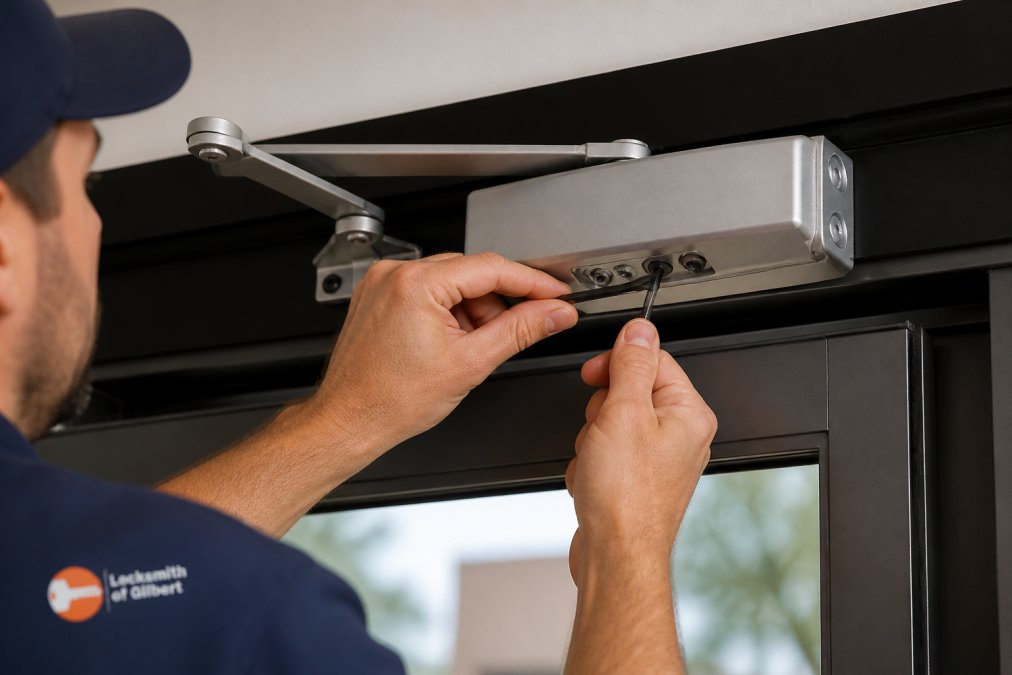
Steps to adjust sweep and latch valves:
- Open the door fully and hold with a doorstop.
- Locate adjustment screws on the end cap (consult your manual).
- Turn the sweep valve clockwise to slow, counterclockwise to speed up. Make quarter-turn adjustments only.
- Test after each adjustment.
- Adjust the latch valve the same way to control final latching speed.
- Make small adjustments; most doors need only a half-turn.
- Test multiple times, accounting for door weight and wind conditions.
Troubleshooting Hydraulic Door Closer Leaking Oil
Hydraulic leaks are the second most common failure. The leak source and severity determine whether repair or replacement is necessary.
-
Clean the closer with a dry cloth to remove old fluid.
-
Place a white cloth under the closer for 24 hours to measure leak rate.
-
Inspect the body and end cap for cracks, loose bolts, or weeping seals.
-
Check mounting bracket bolts (most common source); tighten a quarter-turn with a wrench.
-
Document leak location and rate (slow drip vs. steady leak) to decide repair vs. replacement.
-
Tighten all mounting bolts in a star pattern with an adjustable wrench.
-
Wipe excess oil and monitor for one week.
-
If the leak returns, the seal is failing and replacement is recommended.
-
For persistent leaks from the cylinder body, replacement is necessary.
Preventative maintenance to avoid leaks:
- Monthly visual inspection: Check for oil drips or pooling under the closer. A 30-second walk-around during your regular building inspection is all that's needed.
- Quarterly cleaning: Wipe the closer body with a dry cloth. Dust and debris can trap moisture, which accelerates seal degradation.
- Annual professional service: A technician will check hydraulic fluid level, inspect seals, and test closing speed. This typically costs less than an emergency repair and prevents most failures.
- Avoid over-adjusting valves: Excessive tightening of adjustment screws can damage internal seals. Make only quarter-turn adjustments and test between each change.
- Monitor closing speed: If the door closes noticeably slower than it did a month ago, hydraulic fluid may be leaking internally. This is an early warning sign.
Repair vs. replace decision for leaking closers:
ADA Door Closer Requirements and Compliance Standards
ADA requirements for commercial grade door closer operation:
- Door closing speed: Must take at least 3 seconds to close from 90 degrees to a nearly closed position
- Latching force: Cannot exceed 15 pounds of force to open a door
- Fire-rated doors: Must close completely and latch automatically
- Emergency exit doors: Must open easily from the inside and meet ADA closing speed standards
- Accessible entrances: All accessible doors must have compliant closers
Locksmith Of Gilbert helps commercial property managers stay compliant with accessibility standards. We test closers, adjust them to meet ADA requirements, and document compliance for your records.
When to Repair Versus Replace Your Door Closer
The decision to repair or replace depends on the closer's age, the type of failure, and repair costs.
Repair if:
- The closer is less than 8 years old
- The problem is a stuck adjustment valve or loose mounting bolt
- The closer is a high-quality commercial grade model (worth maintaining)
- The repair cost is less than 40% of replacement cost
- Hydraulic fluid level is low but there's no active leak
Replace if:
- The closer is older than 12 years
- Hydraulic fluid is actively leaking from the cylinder body
- The closer has failed multiple times in the past 2 years
- Replacement cost is similar to repair cost
- The closer doesn't meet current ADA or fire code standards
- The internal piston is damaged (you'll see sluggish, inconsistent closing)
Preventative Maintenance for Commercial Hardware
Regular maintenance prevents most door closer failures. A simple monthly inspection and annual service extend the life of your hardware by years.
Monthly maintenance checklist:
- Visually inspect for hydraulic fluid leaks or drips
- Test the door closing speed, should feel smooth and controlled
- Check that the door latches completely
- Listen for unusual sounds like squeaking or hissing
- Verify the door doesn't drift open after closing
Annual professional service:
- Full cleaning and lubrication of external components
- Hydraulic fluid level check and top-up if needed
- ADA compliance testing (closing speed and latching force)
- Inspection of mounting bracket bolts and fasteners
- Replacement of worn o-rings and seals if accessible
Frequently Asked Questions
Can you repair a commercial door closer or is replacement necessary?
Many commercial door closer problems can be repaired without full replacement. Common repairs include adjusting sweep and latch valves, replacing worn seals and o-rings, and fixing leaking hydraulic fluid. However, if the internal piston is damaged, the arm assembly is bent, or the door closer has reached the end of its service life, replacement is the safer and more cost-effective option. A professional inspection determines whether repair or replacement makes sense for your specific situation.
What are the most common signs that a commercial door closer needs repair?
Watch for doors that close too slowly or too quickly, doors that slam shut, doors that won't latch completely, visible oil leaks around the end cap or pivot point, and doors that drift open on their own. These signs indicate issues with the hydraulic fluid, valve adjustment, or internal seals. Addressing these problems early prevents further damage and maintains ADA compliance and fire-rated door functionality.
How do I adjust the closing speed on a commercial door closer?
Closing speed is controlled by the sweep valve, typically located on the side of the door closer body. Use an adjustable wrench or screwdriver to turn the adjustment screw clockwise to slow the closing speed or counterclockwise to speed it up. Make small quarter-turn adjustments and test the door between each change. The door should close smoothly without slamming. If you're unsure about the correct setting for your building's fire-rated doors or ADA requirements, consult a professional.
Are there ADA compliance requirements for commercial door closers?
Yes. The ADA requires that doors in public buildings close slowly enough for people with disabilities to pass through safely. Commercial door closers must meet specific closing speed and latching force standards set by the ADA. Fire-rated doors have additional requirements to ensure they close fully and seal properly. If your building houses public spaces, regular maintenance and proper adjustment of your door closers is essential to remain compliant and avoid liability issues.